Quick Comparision
The Merchant Navy and the Indian Navy are completely different professions. The former is a civilian maritime industry responsible for transporting cargo and passengers and supporting global trade. At the same time, the latter is a military service responsible for defending India’s maritime interests and territorial waters. Although both operate at sea and wear similar-looking uniforms, they serve entirely different purposes and have very different responsibilities.
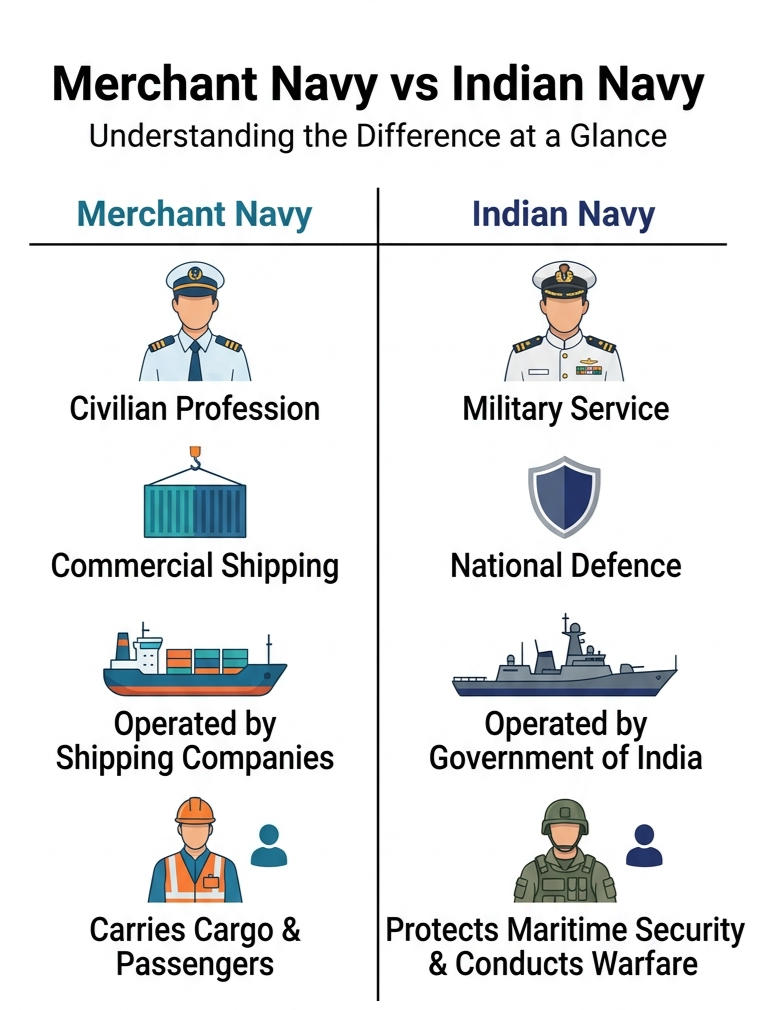
Understanding the Difference Between Merchant Navy and Indian Navy
One of the most common misconceptions among aspiring cadets and parents is that the Merchant Navy is part of the armed forces. This misunderstanding often creates unnecessary confusion and apprehension. Understanding the difference early on helps you evaluate your career options and interests more accurately. It also prevents confusion when researching training institutes, careers, qualifications, and future opportunities.
Merchant Navy vs Indian Navy: Key Differences at a Glance
- The Merchant Navy is a civilian profession.
- The Indian Navy is a military service.
- Merchant ships support trade and transportation.
- Naval ships support national defence and security.
- Merchant Navy personnel are employed by shipping companies and maritime organisations.
- Indian Navy personnel serve under the Government of India.
- Similar uniforms do not mean the two professions are the same.
Purpose, Roles and Responsibilities
The easiest way to tell the two apart is by looking at their purpose. The Merchant Navy exists to support trade and commerce. Merchant ships transport goods, fuel, raw materials, vehicles, containers, and passengers between ports around the world. For example, a container ship arriving at a commercial port to load or discharge cargo is operating as part of the Merchant Navy.
The Indian Navy exists to protect the nation’s maritime interests. Its responsibilities include defence, maritime security, surveillance, humanitarian assistance, and search and rescue operations when required. For example, a destroyer conducting maritime security patrols or participating in a naval exercise is operating as part of the Indian Navy. Naval vessels are military assets operated for national security rather than commercial transportation.
Types of Ships Used by the Merchant Navy and Indian Navy
You can also spot the difference by looking at the ships themselves. Merchant Navy vessels are designed to transport cargo, passengers, or provide specialised maritime services. Examples include container ships, tankers, bulk carriers, passenger vessels, and offshore support vessels.
Indian Navy ships, such as destroyers, frigates, aircraft carriers, and submarines, are designed for defence and security operations. Their equipment, mission, and operational requirements differ significantly from those of commercial vessels.
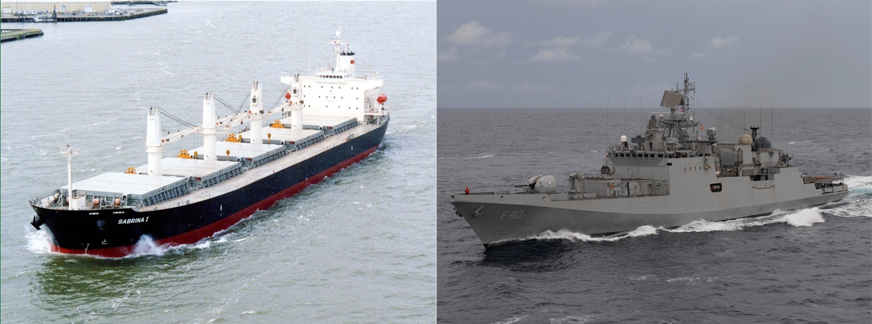
Their training is different too. While both careers demand professionalism and discipline, they are trained for entirely different roles and responsibilities.
Merchant Navy vs Indian Navy: Eligibility Criteria
Although both professions require candidates to meet educational and medical standards, their eligibility requirements differ because they prepare individuals for entirely different careers.
Merchant Navy officer training programmes generally require candidates to have completed Class 12 with Physics, Chemistry, and Mathematics, along with meeting medical fitness standards prescribed for seafarers. Eligibility may vary depending on the course and shipping company.
The Indian Navy has separate eligibility criteria based on the branch and mode of entry, with requirements relating to education, age, physical fitness, and medical standards. Since recruitment policies may change periodically, candidates should always refer to the latest official notifications before applying.
Merchant Navy vs Indian Navy: Recruitment Process
The recruitment process is another major difference between the Merchant Navy and the Indian Navy.
Merchant Navy recruitment is primarily conducted by shipping companies and approved maritime training institutes. Depending on the career pathway, candidates may obtain company sponsorship before beginning pre-sea training or apply for employment after completing an approved maritime course. Selection typically involves aptitude assessments, interviews, document verification, and medical examinations.
In contrast, the Indian Navy recruits personnel through government-conducted selection processes that may include written examinations, interviews, physical fitness assessments, and medical evaluations, depending on the branch and type of entry.
Merchant Navy vs Indian Navy: Which Is Better?
Neither the Merchant Navy nor the Indian Navy is objectively better, as each offers a distinct career path with its own responsibilities, lifestyle, and opportunities.
The Merchant Navy may appeal to individuals interested in international shipping, commercial operations, and a civilian maritime career. The Indian Navy is better suited to those who wish to serve in the armed forces, contribute to national defence, and work within a structured military environment.
Choosing between the two depends on your personal interests, career goals, and the type of professional life you want to pursue, rather than comparing one profession as superior to the other.
Common Misconceptions About Merchant Navy and Indian Navy
- Believing the Merchant Navy is part of the Indian armed forces.
- Assuming Merchant Navy officers hold military status.
- Thinking merchant ships are warships.
- Assuming Merchant Navy training automatically leads to service in the Indian Navy.
- Believing similar uniforms mean both professions perform the same role.
It’s easy to see why people confuse the two professions. Both work at sea, use maritime terminology, and wear uniforms. However, these similarities do not make them the same profession. Once this distinction is clear, understanding ship types, maritime departments, training pathways, qualifications, and career options becomes much easier.
Frequently Asked Questions
1. Is the Merchant Navy part of the Indian Armed Forces?
No. The Merchant Navy is a civilian industry that transports cargo and passengers by sea. Merchant ships are operated by shipping companies and keep global trade moving. Although they play an important role in the economy, they are not part of the Indian Armed Forces.
2. Are Merchant Navy officers military officers?
No. Merchant Navy officers are civilian seafarers employed by shipping companies. Their job is to operate commercial ships safely and efficiently, whether in navigation, engineering, or cargo operations. They do not hold military commissions or perform defence-related duties.
3. Why do the uniforms sometimes look similar?
Many maritime professions use uniforms and rank structures to maintain discipline and clear authority on board. As a result, the uniforms worn by the Merchant Navy, Coast Guard, and naval forces can look similar. However, similar uniforms do not mean they perform the same role or belong to the military.
4. Which profession involves military training?
The Indian Navy provides military training for national defence, combat, and security operations. Merchant Navy training prepares seafarers to operate commercial ships safely, manage cargo, and comply with international maritime regulations. Although both careers work at sea, they are trained for very different roles.
5. Do merchant ships receive protection from naval forces in high-risk areas?
Yes. In some high-risk areas, naval forces patrol shipping routes and may provide security assistance to commercial vessels. Merchant ships also follow international security procedures and coordinate with naval authorities when required. Even so, they remain civilian ships operated by commercial shipping companies
References and Further Reading
- Directorate General of Shipping (DG Shipping), Government of India https://dgma.gov.in/
- Indian Navy. https://indiannavy.gov.in/
- Ministry of Ports, Shipping and Waterways (MoPSW). https://shipmin.gov.in/

Abhiraj Singh is a seafarer, maritime technical writer, and lifelong learner with a passion for exploring the world of shipping beyond the bridge and engine room. His writing covers merchant ships, navigation, seamanship, cargo operations, maritime regulations, shipboard safety, and the technologies that keep global trade moving. Through IMUmate, he contributes educational content designed to prepare the next generation of seafarers for both examinations and life at sea.